 GameCaddie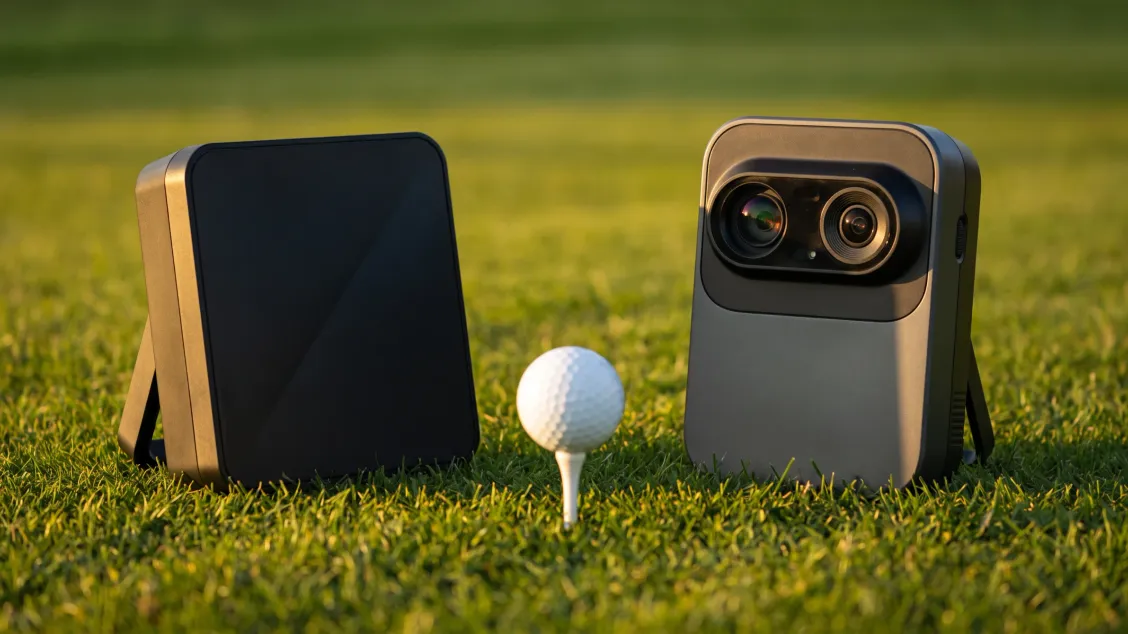
Quick answer
Every price here comes from Garmin’s and Rapsodo’s own pages or their App Store listings, checked in August 2026.
| Dimension | Garmin Approach R10 | Rapsodo MLM2PRO |
|---|---|---|
| Hardware price | $499.99 (launched at $599.99) | $599.99, listed as $100 off $699.99 |
| How it sees the ball | Doppler radar | Radar plus dual optical cameras |
| Spin | Calculated from ball flight | Measured, RPT balls only |
| Subscription | $99.99/yr or $9.99/mo for simulator play | $199.99/yr, $329.99/2yr, $599.99 lifetime |
| Free without a subscription | Range metrics | Basic features only |
| Virtual courses | 43,000+ (Home Tee Hero) | 30,000+ plus 2 virtual ranges |
| Video | Swing video, cloud storage on membership | Impact Vision at 240 fps, 10,000-swing library |
| Battery | Up to 10 hours | Not published |
| App platforms | iPhone, iOS 18+ | iPhone, iPad, Vision Pro, iOS 15.6+ |
| Three-year cost with simulator | $799.96 | $1,199.96 |
The shelf price is the wrong number
A hundred dollars separates these two on the shelf. Four hundred separates them after three seasons, because the subscriptions are nowhere near each other.
| Route | Year 1 | Three years | Five years |
|---|---|---|---|
| R10, range practice only | $499.99 | $499.99 | $499.99 |
| R10 with Garmin Golf | $599.98 | $799.96 | $999.94 |
| MLM2PRO with annual Premium | $799.98 | $1,199.96 | $1,599.94 |
| MLM2PRO with lifetime Premium | $1,199.98 | $1,199.98 | $1,199.98 |
Only the R10 can be run for free forever. Garmin’s app hands you range metrics without a membership and charges only for Home Tee Hero, green contours and video storage, so a golfer who never plays virtual rounds pays $499.99 and stops.
Rapsodo’s pricing has a threshold worth knowing. Three annual renewals at $199.99 come to $599.97, and Lifetime Premium costs $599.99, so the two are a wash through three years. Every year after that, lifetime is pure savings: a fourth renewal takes annual to $799.96 while lifetime stays at $599.99. Buy lifetime if you expect to still own the unit in 2030.
What each one actually measures
The R10 uses radar alone. The MLM2PRO adds two cameras, and that single hardware difference decides which numbers on your screen were measured and which were inferred.
The R10 is radar, and radar guesses at spin
The R10 is a Doppler radar unit that sits behind the ball, reports more than a dozen metrics including club head speed, ball speed, launch angle and spin, and runs about 10 hours on a charge. Garmin sold it from August 2021 at $599.99 and it now sits at $499.99.
Spin is the asterisk. Radar in this price band infers spin from how the ball flies rather than watching the ball rotate, and the shorter the shot, the less flight there is to read.
The MLM2PRO watches the ball with cameras
Rapsodo pairs radar with two optical cameras. Its product page lists 15 metrics with 8 of them measured: ball speed, club speed, launch angle, launch direction, angle of attack, club path, spin rate and spin axis. Carry, total distance, apex, descent angle, side carry, smash factor and shot type are the estimated seven.
Measured spin has a condition attached, and Rapsodo states it plainly. A Titleist or Callaway RPT ball is required to show spin numbers, because the cameras read markings printed on those balls. Three come in the box with the unit, a tripod, a charging cable and a 45-day Premium trial. Hit a normal ball and the spin fields stay empty.
What testers found
Garmin publishes its own accuracy spec, and reviewers have checked it. Plugged In Golf lists Garmin’s claim as 3 mph on club speed, 1 mph on ball speed, 1 degree on launch angle and direction, and 5 yards of carry against a TrackMan. Matt Saternus found the R10 “was well within those parameters the vast majority of the time” and “often perfectly in line with a professional grade launch monitor outdoors,” with indoor accuracy acceptable but less consistent.
His one flagged parameter was spin, which ran high on wedges and mishits. That matches what radar physics predicts, and it is the exact gap Rapsodo’s cameras are built to close.
Golf Monthly’s R10 review praises the data volume and accuracy while listing two cons: the unit is temperamental about alignment, and it has no ball normalization, so worn range balls skew your distances. Their MLM2PRO review by Mike Bailey calls it “a great practice tool that provides accurate data,” with easy setup and useful video, and lists the same two catches everyone else finds: spin metrics are not a given, and the membership is required to keep the best features.
Read those together and a pattern shows up. Neither unit is being criticized for the numbers a range session lives on. Both get flagged for the conditions attached to their best features.
Space, portability, and what you carry
Indoors, both units need the ball to fly a bit before they know anything. Rapsodo asks for a little more than 14 total feet: roughly 8 feet from ball to net, plus 6.5 to 8.5 feet behind the ball for the unit itself. The R10 is a small radar box on a similar footprint behind the ball, and its documented weak spot is aiming, since a device that size is easy to misalign by a couple of degrees.
The phone side is worth checking before you buy. The Garmin Golf App Store listing shows iPhone only and iOS 18 or later. The Rapsodo app runs on iPhone, iPad and Apple Vision from iOS 15.6. If your simulator plan involves propping up an iPad, that difference decides it.
Which one fits you
- You want the cheapest way into simulator golf: R10 at $499.99 plus $99.99 a year, with 43,000-plus courses in Home Tee Hero.
- You want to spend nothing after the hardware: R10 and skip the membership, which still leaves you full range metrics.
- You want spin you can trust on wedges: MLM2PRO, and commit to buying RPT balls.
- You want swing video as part of practice: MLM2PRO, whose 240 fps Impact Vision has no R10 equivalent.
- You are keeping the launch monitor for years: MLM2PRO with lifetime Premium at $599.99, which costs less than annual renewals from year four onward.
- You practice on an iPad: MLM2PRO, since Garmin’s app lists iPhone only.
- You mostly hit outdoors at a range: R10, which testers rate highest outdoors and which lasts 10 hours on a charge.
Mistakes buyers make with both
Judging either one on shelf price. The subscription is the larger number by year three on both.
Expecting spin from range balls. Rapsodo needs RPT markings, and the R10 has no ball normalization at all, so a bucket of scuffed range rocks corrupts distance data on either unit.
Buying a launch monitor to fix a swing it has not diagnosed. These tell you what happened at impact. What to do about it is a separate job, and swing analyzer apps cover different ground.
Paying for a simulator you will not use in July. Garmin’s membership is monthly at $9.99, so a winter-only simulator golfer can pay for four months instead of twelve and save $60.03 a year.
The honest verdict
The R10 is the better buy for most golfers, and the reason is the subscription rather than the hardware. It costs $100 less on the shelf, $100 less every year after, gives you 13,000 more virtual courses, and can be run with no subscription at all. Its accuracy on the numbers that matter for range work held up in independent testing.
The MLM2PRO earns its price in one specific case: you want measured spin and impact video, and you are willing to buy RPT balls and lifetime Premium to get them. That is a real reason and a narrow one. If the phrase “spin axis” has never come up in your practice, you are paying $400 over three years for a number you will not read.
The next step
A launch monitor tells you what your swing produced, and turning that into fewer strokes is a different job. GameCaddie builds apps for that, so read this with the bias in plain sight. When your numbers point at equipment, a golf ball fitting covers 72 ball models in about 90 seconds, and when they point at your swing or short game, a golf practice plan turns your worst category into range work with a purpose. Both are free to start with no card, nothing inside them comes from an affiliate deal, and MyBagCaddie handles gapping once your carry numbers are real.
Ready to act on what your numbers show? Find your ball, Build an AI practice plan, or Get every app.
For deeper dives
- What is a good golf handicap? The real numbers
- Best golf launch monitor under $600: the real cost
- Shot Scope vs Arccos: which tracker is worth it in 2026
- Golf shot tracker apps: what each one costs in 2026
- Golf swing analyzer apps: what they can and can’t tell you
Key takeaways
- The R10 costs $499.99 plus $99.99 a year. The MLM2PRO costs $599.99 plus $199.99 a year.
- Three years with simulator play: $799.96 for the R10, $1,199.96 for the MLM2PRO.
- Rapsodo’s lifetime Premium at $599.99 matches three annual renewals to the penny and saves money from year four onward.
- The R10 calculates spin and runs high on wedges. The MLM2PRO measures it, but only with a Titleist or Callaway RPT ball.
- Only the R10 can be used with no subscription at all, which still leaves full range metrics.
- Garmin’s app lists iPhone only. Rapsodo’s runs on iPhone, iPad and Apple Vision.