 GameCaddie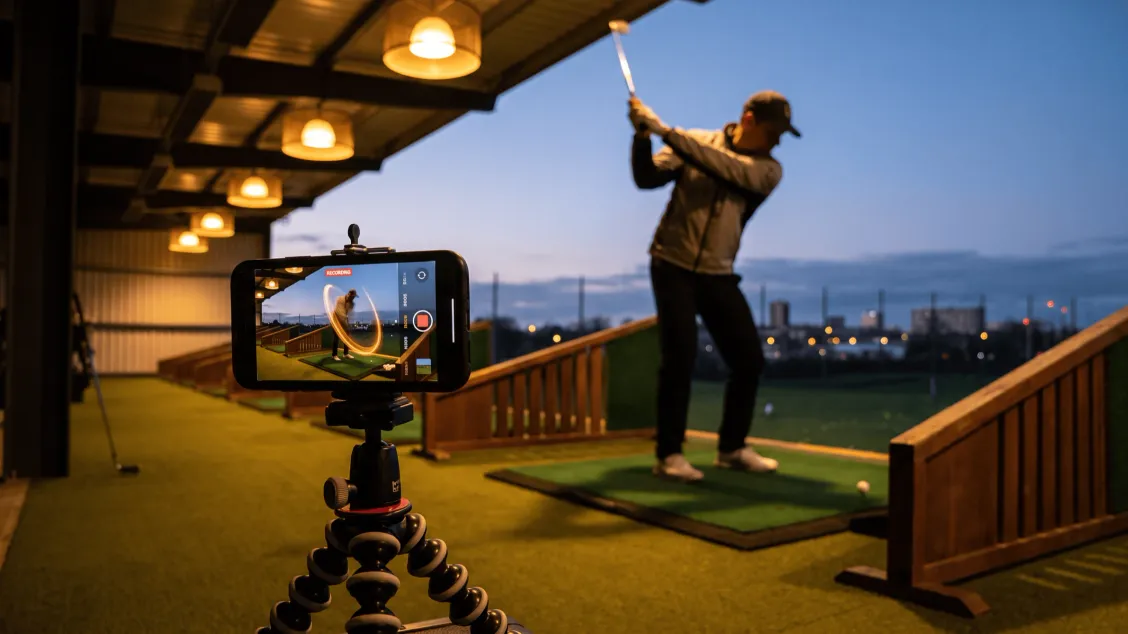
Quick answer
| App | Verified 2026 price | Platform | What the analysis does |
|---|---|---|---|
| V1 Golf | $9.99/mo or $69.99/yr (official site) | iOS, Android | Slow-mo, frame-by-frame, drawing tools, side-by-side with model swings |
| OnForm | Personal $4.99/mo or $49.99/yr (App Store) | iOS | Video analysis + coach messaging tiers, 14-day trial |
| Sportsbox 3D Golf | Player $15.99/mo or $109.99/yr (App Store) | iOS | AI markerless 3D measurement of body angles from one phone video |
| Your camera app | $0 | Recent iPhones, flagship Androids | 240fps slow-mo, no measurement, no comparison |
How the analysis actually works
Camera-based apps like V1 Golf work on 2D video: you film at high frame rate, then scrub frame by frame, draw plane lines and angles, and run your swing beside a model or your own baseline. The measurement is whatever the pixels show from that one angle.
Sportsbox 3D Golf takes the AI route: markerless motion capture that estimates 3D body positions (turn, sway, lift, side bend) from a single phone video, the same category of tech used with 3D lab systems but without the markers. The output is numbers over time instead of lines on a frame.
The difference matters for what you can trust. A 2D line depends entirely on where the camera stood. A 3D estimate is camera-tolerant but still an estimate.
What the independent tests say
The best available accuracy check on phone-based 3D is an informal comparison of Sportsbox against an AMM marker-based system: agreement within about 2 degrees on angular measures and about half an inch on linear ones. Reviewers who use it for coaching, like Golficity’s hands-on review, land in the same place: precise enough to measure real swing changes, and still a coaching aid rather than lab ground truth. We could not find a peer-reviewed golf-specific validation study of markerless capture as of mid-2026, which is worth knowing before treating the numbers as gospel.
For 2D video, the accuracy ceiling is your tripod discipline. A camera a few feet off the target line, or at knee height instead of hip height, changes the apparent swing plane and can manufacture an “over the top” move that does not exist. Same swing, different camera spot, different diagnosis.
Who these apps fit
- The rangefinder-owner who practices alone: V1 Golf, because side-by-side comparison against your own best swing is the highest-value feature per dollar at $69.99/yr.
- The golfer taking occasional remote lessons: OnForm, because the coach messaging pipeline is the product, and $49.99/yr undercuts the field.
- The improver chasing measurable positions: Sportsbox 3D, if the $109.99/yr buys numbers you will keep tracking between range sessions.
- The golfer who has never filmed a swing: your phone’s built-in 240fps slow-mo, for free, this week. Upgrade to an app when you want measurement and comparison.
Who they don’t fit
- Anyone expecting a diagnosis. Teaching pros are consistent: amateurs self-diagnosing from one angle routinely fix the wrong fault. The app shows five quirks; a coach knows which one costs strokes.
- Golfers whose scoring problem is not the full swing. Strokes-gained research shows approach play and course decisions separate handicap bands more than swing aesthetics. If you shoot 95 with a pretty swing, the handicap math will point at a different leak.
- On-course use. Filming every swing during a round is impractical and mostly against the spirit of the rules for advice. These are practice-tee tools; on the course, a watch GPS app is the tech that belongs on your wrist.
The next step
Filming your swing tells you what it looks like. Lowering your handicap needs the rest of the picture: Build an AI practice plan that attacks your measured leaks, Find your ball with a 90-second brand-neutral fitting (full disclosure: both apps are ours, free to start, no affiliate deals anywhere in the suite), or Get every app.
For deeper dives
Key takeaways
- V1 Golf ($69.99/yr) leads for video self-review, OnForm ($49.99/yr) for remote coaching value, Sportsbox 3D ($109.99/yr) for AI 3D measurement.
- Phone-based 3D measurement tested within about 2 degrees of a marker-based lab system in informal comparison, but no peer-reviewed golf validation exists yet.
- Camera placement is the top source of false readings in 2D analysis; film down the line and face on from consistent, hip-height positions.
- The apps measure; they do not prioritize. Pair them with a coach or with data on where your strokes leak before rebuilding anything.