 GameCaddie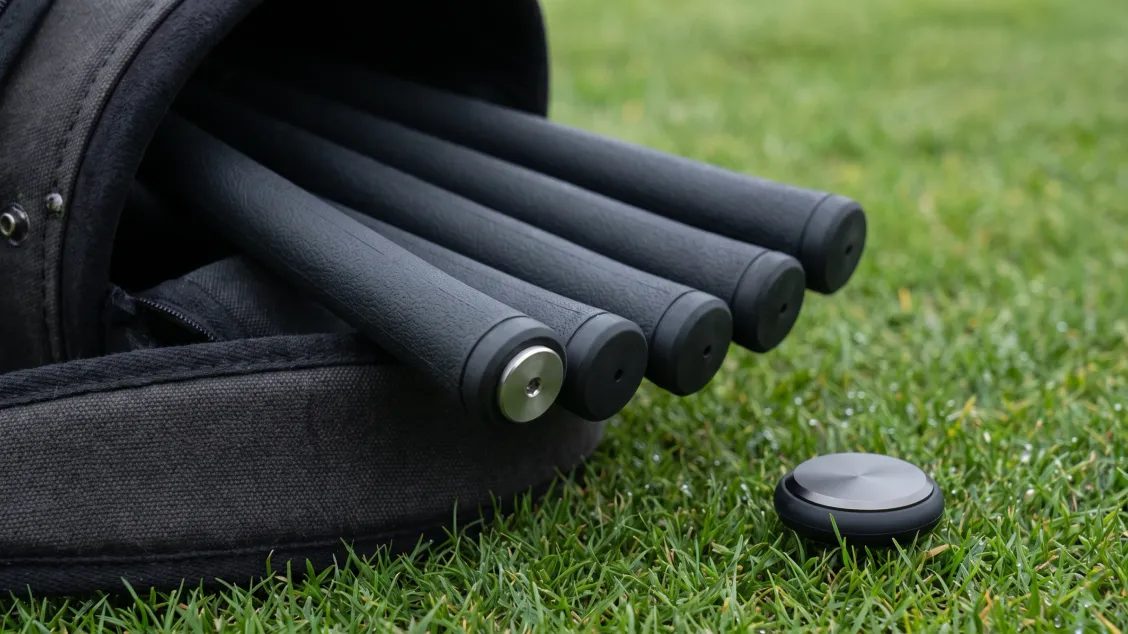
Quick answer
Every price here comes from each company’s own US store page or App Store listing, checked in August 2026.
| Dimension | Shot Scope | Arccos |
|---|---|---|
| Entry hardware | V5 watch, $249.99, 16 tags included | Smart Sensors, $249.99 (16) or Air, $349.99 |
| Recurring cost | $0, “100% subscription free for life” | $199.99/yr after the included first year |
| Three seasons | $249.99 | $649.97 sensors, $749.97 Air |
| How it knows the club | Tag in every grip, read by the watch | Sensors read the grip; Air infers it from distance |
| Where the receiver sits | Your wrist, so the phone can stay in the bag | Your phone (sensors) or the Air wearable |
| Stats | 100+ tour-level stats, strokes gained, free web dashboard | Strokes gained, AI strategy, LiDAR green maps on 9,000+ US courses |
| Tested detection | Minimal post-round editing on the V5 | Air: 99% of shots, 80% to 90% club accuracy |
| Tracking with no club hardware | Apple Watch app only, 3 free rounds then $149.99 once, manual entry | Air, $349.99, fully automatic |
| Platforms | iOS and Android | iOS and Android |
What each one is built to do
Shot Scope sells hardware once and leaves you alone
The V5 is a GPS watch with a tracking system bolted on. You screw a 3-gram tag into the butt of every grip, wear the watch, and it records club and location at impact with no input from you. Shot Scope’s own V5 page lists 36,000+ preloaded courses, over 100 tour-level stats including strokes gained and handicap benchmarking, and 2-plus rounds of battery in GPS mode.
The business model is the interesting part. Shot Scope guarantees its “software, maps and updates are 100% subscription free for life,” and the web dashboard costs nothing. The X5 runs $299.99 and the G6 $179.99 if you want a different watch, and a replacement 16-pack of tags is $34.99.
Arccos sells a subscription with hardware attached
Arccos gives you two ways in. Smart Sensors cost $249.99 for 15 club sensors plus a putter sensor, working the same way Shot Scope’s tags do, with your phone as the receiver instead of a watch. Air costs $349.99, clips to a belt or sits in a pocket, and attaches nothing to your clubs at all.
Both include the first year of the game tracking membership, which renews at $199.99 a year. What that buys is the analytics layer: the App Store listing describes strokes gained, AI round summaries, drill recommendations, and green maps LiDAR-mapped to 1mm precision across 9,000+ US courses and 3,000+ worldwide.
Price over three seasons
Up-front price is the least useful number on either product page. Run it out three seasons and the systems stop looking similar:
- Shot Scope V5: $249.99 total. Watch, 16 tags, app, maps, 100+ stats, done.
- Arccos Smart Sensors: $249.99, then two renewals at $199.99, so $649.97.
- Arccos Air: $349.99, then two renewals at $199.99, so $749.97.
- Shot Scope Apple Watch app only: $149.99 once, and you tap in every shot yourself.
So Arccos costs about $400 more than Shot Scope over three seasons for the sensor route, and $500 more for Air. There is one discount worth knowing: Arccos knocks $100 a year off the Air renewal if you bundle it with the Smart Laser and keep both. Garmin’s CT10 tags, 18Birdies and Golfshot sit in the same cost frame, and the full shot tracker field has that table.
That extra money goes to the analytics layer: AI club strategy off the tee, plays-like distances, and the green maps. Shot detection is a wash between the two, as the next section shows. If you open the app after every round and change what you practice because of it, $199.99 a year is a fair trade. If you check your stats twice a season, you are renting features you never read.
Accuracy and data quality
Neither system misses many shots. Plugged In Golf’s Arccos Air review (Zack Buechner, May 2026) registered “99% of the shots” hit during testing and put club selection at an “80-90% accuracy rate” over multiple rounds, with post-round cleanup needed because Air guessed wrong on low shots under trees and on balls that clipped something mid-flight.
Grip hardware skips that guessing entirely. Reviewing the V5 in April 2024, Matt Saternus wrote that Shot Scope “continues to provide the best shot tracking experience in golf,” needing minimal editing even after a test round with extra shots thrown in, and got 36 holes from one charge. Arccos Smart Sensors sit in the same category, since a transmitter bolted to a club cannot mistake it for a different one.
The real split is sensorless convenience against grip-mounted certainty, and Arccos sells hardware on both sides of it. Both companies publish their own amateur benchmarks, and the numbers disagree. Arccos’s 2025 driving distance report drew on a sample of 25,000 users and 6.5 million shots from more than 4 million rounds, and Golfweek’s coverage of the follow-up found amateur driving distance flat since 2018. Shot Scope’s published data shows greens in regulation falling from 62% at scratch to 9% for a 25 handicap.
Each of those describes that company’s own users under its own definitions, so treat them as directional. Vendor improvement claims deserve harder skepticism: Arccos markets that new members lower their handicap by 25% on average in year one, which is the company’s own figure with no independent replication.
Day to day on the course
Setup is a wash. Both systems mean screwing 14 to 16 small pieces of hardware into your grips once, and Shot Scope’s tags come pre-labeled so nothing needs pairing. Air skips that step completely, which is its entire argument.
Where you feel the difference is what you carry. Shot Scope puts the receiver on your wrist, so your phone can live in the bag on silent for four hours. Arccos Smart Sensors need the phone with you, though Arccos also runs on Apple Watch and Wear OS. Air is the smallest thing to carry and the only one that asks nothing of your clubs, and it charges over USB-C in a case Arccos rates at about 12 rounds.
Post-round is where the money shows up. With tags, editing means fixing the occasional stray shot. With Air, expect to correct a club or two per round for the first stretch while its distance history fills in.
Which one fits you
- You want automatic tracking and no yearly bill: Shot Scope V5, $249.99, nothing after that.
- You refuse to put hardware on your clubs: Arccos Air, $349.99 plus $199.99 a year, and accept the club edits.
- You want the deepest analytics and will read them every week: Arccos Smart Sensors, $249.99, and budget the renewal from day one.
- You already wear an Apple Watch and are not sure tracking will stick: Shot Scope’s app-only route, 3 free rounds then $149.99 once, with manual entry.
- You play fewer than 15 rounds a year: skip Arccos’s renewal math and buy the Shot Scope watch.
- You want strategy help, not just a record: Arccos, whose AI club recommendations and green maps have no Shot Scope equivalent.
The honest verdict
Shot Scope V5 is the right buy for most golfers, and the deciding factor is the renewal rather than the tracking. Both systems catch your shots, both compute strokes gained, and both will tell you whether your approach play or your putting is costing more. One of them stops charging you after $249.99.
Arccos earns its price in a narrower case: you want the AI strategy layer, or you want Air’s freedom from club hardware badly enough to pay $500 more across three seasons. Those are real reasons, and they belong to a minority of golfers buying a first tracker.
The next step
A tracker shows you where the strokes go. Fixing what it finds is a separate job, and GameCaddie builds apps for that, so read this with the bias in plain sight. Once your stats point at equipment, a golf ball fitting covers 72 ball models in about 90 seconds. Once they point at your swing or your short game, a golf practice plan turns your worst category into range work with a purpose. MyBagCaddie handles the bag side of what tracking surfaces. BallCaddie and PracticeCaddie are both free to start with no card, and no pick inside them comes from an affiliate deal.
Ready to act on what your tracker found? Find your ball, Build an AI practice plan, or Get every app.
For deeper dives
- What is a good golf handicap? The real numbers
- Golf shot tracker apps: what each one costs in 2026
- Best golf handicap app: official USGA index or estimate?
- Best golf app for Apple Watch: 2026 picks and prices
Key takeaways
- Shot Scope costs $249.99 once. Arccos costs $249.99 or $349.99 plus $199.99 every year after the first.
- Three seasons: $249.99 for a V5, $649.97 for Arccos Smart Sensors, $749.97 for Air.
- Grip hardware reads your club. Air infers it, and one reviewer counted 80% to 90% correct with post-round cleanup required.
- Arccos’s extra money buys AI strategy and LiDAR green maps on 9,000+ US courses, not better shot detection.
- Shot Scope’s Apple Watch app tracks manually for $149.99 once after 3 free rounds, which is the cheapest way to find out whether tracking sticks.