 GameCaddie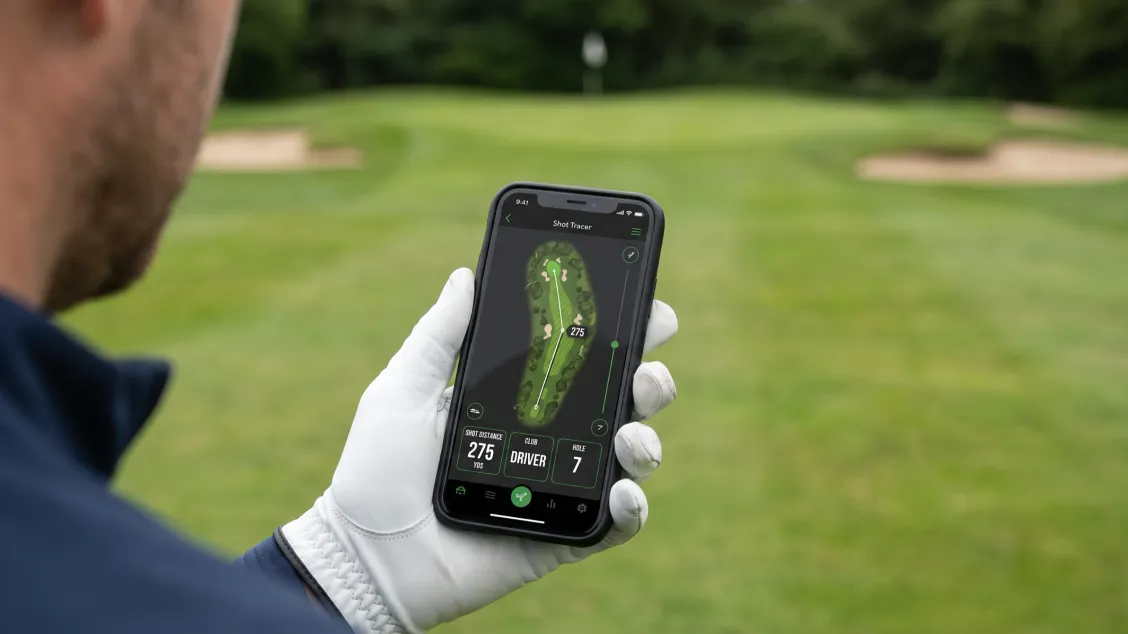
Quick answer
Prices below come from each company’s own store or product page, checked in August 2026. Garmin’s CT10 figures are its published MSRP:
| System | How it tracks | Up front | Every year after |
|---|---|---|---|
| 18Birdies | Manual free; automatic Smart Tracking on Premium | $0 | $0 free tier, or $99.99 Premium |
| Golfshot | Manual free, auto via smartwatch on Pro | $0 | $0 free tier, or $79.99 Pro |
| Shot Scope V5 | 16 screw-in tags plus GPS watch | $249.99 | $0, subscription free for life |
| Arccos Smart Sensors | Grip-end sensors plus your phone | $249.99 | $199.99, first year included |
| Garmin Approach CT10 | 14 screw-in sensors plus a Garmin golf watch | $299.99 | $0 for the sensors |
| Arccos Air | Pocket wearable, no club hardware | $349.99 | $199.99, first year included |
What three seasons of tracking costs
Shot trackers are sold on the up-front price, and that is the least useful number. Run it out three seasons instead:
- Shot Scope V5: $249.99 total. The watch, 16 tags, the app, the maps and 100+ stats, done.
- Arccos Smart Sensors: $249.99, then two renewals at $199.99, so $649.97.
- Arccos Air: $349.99, then two renewals at $199.99, so $749.97. The highest fixed total here, and the only one with nothing to attach to a club.
- Golfshot Pro: $239.97, and you need a smartwatch you already own for the automatic mode.
- Garmin Approach CT10: $299.99 for the full 14-sensor set, plus a compatible Garmin golf watch. The sensors do nothing on their own, so the real total depends on which watch you buy.
- 18Birdies free tier: $0, and you tap every shot yourself.
The $400 gap between Arccos Smart Sensors and Shot Scope buys analytics depth rather than better shot detection (against Air the gap is $499.98). Arccos’s App Store listing describes strokes gained by club, AI club strategy off the tee, plays-like distances adjusted for weather, and LiDAR green maps on 9,000+ US courses. Shot Scope’s V5 page lists strokes gained, handicap benchmarking and club yardages with no recurring bill. If you open the app twice a season, you are renting features you do not read.
What free manual tracking gets you
The free tiers are more capable than golfers expect. 18Birdies includes GPS on 45,000+ courses, shot tracking, stat recording, scoring and its watch app at no cost, with strokes gained, club recommendations and automatic Smart Tracking held back for the $99.99 a year Premium plan. Golfshot’s free tier covers 47,000+ courses with manual shot tracking and basic stats, while automatic shot and putt tracking sit inside Pro at $79.99 a year.
Manual tracking has one failure mode, and it is you. Every shot needs a tap, a club confirm and a location, on every hole, in a group that wants to keep moving. Plenty of golfers keep it up for a few rounds and then quietly drop back to logging tee shots only, which leaves a hole in the dataset exactly where the strokes are going.
If you know you will not keep it up, buy tags. If you play twice a month and like the ritual of logging, free is fine.
Arccos Air changed the question
Until March 2026, automatic tracking that knew your club meant screwing a transmitter into the butt of every grip. Arccos Air removed that step. It is a wearable smaller than an AirPods case that clips to your belt or rides in a pocket, detects swings from its own motion sensors and GPS, and ships with a charging case good for about 12 rounds. Your phone can stay in the bag.
The catch is club identification. A grip sensor knows which club swung because the transmitter is bolted to it. Air has to infer the club from your distance history, a feature Arccos calls Smart Club Selection, and two reviewers who counted put that guessing at very different rates. Breaking Eighty found shot detection “was strong” and “caught almost everything” while club identification landed right about 60% to 70% of the time, with “at least one club” needing a correction on most holes. Plugged In Golf measured 80% to 90% after post-round cleanup. Both concluded the same thing: sensors remain the lower-maintenance, more accurate option.
So Air buys convenience and costs you editing time. At $349.99 it is also the priciest entry in this list, and Smart Sensors are still sold at $249.99 and still supported. You can even run both.
Shot Scope puts the receiver on your wrist, so your phone can stay in the bag and there is no membership at all. Extra tags run $34.99 for a 16-pack if you add clubs.
Garmin Approach CT10 only makes sense if you already wear a Garmin golf watch. At $299.99 for 14 sensors (or $79.99 for a 3-sensor starter pack) with no subscription, it is a good deal for existing Garmin owners and an expensive entry point for everyone else.
Whichever you pick, Arccos still has the biggest dataset in consumer golf behind it: its 2025 driving distance report drew on 25,000 users and 6.5 million shots from more than 4 million rounds, and the App Store listing says the AI is trained on 1.5 billion shots.
What the tracking data is for
The point of any of this is finding the leak. Shot Scope’s published amateur data shows greens in regulation collapsing from 62% for a scratch golfer to 9% for a 25 handicap. A gap that size puts approach play well ahead of putting on most mid handicap fix lists, and a handful of tracked rounds will show whether it holds for your game.
One honest caveat: Arccos and Shot Scope publish different scratch GIR figures (roughly 51% and 62%), because each number describes that company’s own users under its own definitions. Use these as directional benchmarks, not a census of American golf. Your own 20-round average is the only number that is unarguably about you.
Vendor improvement claims deserve the same skepticism. Arccos markets that new members lower their handicap by 25% on average in year one. It is the company’s own figure with no independent replication, so it belongs in the marketing column. What tracking reliably does is remove the guessing, and what counts as a good golf handicap becomes a lot easier to chase once you know which club is bleeding.
Which one to buy
- You want automatic tracking and hate subscriptions: Shot Scope V5, $249.99, nothing after.
- You refuse to put hardware on your clubs: Arccos Air at $349.99, and accept that you will fix some club assignments after the round.
- You want the most accurate club-by-club data: Arccos Smart Sensors at $249.99, and budget the $199.99 renewal from day one.
- You already own a Garmin golf watch: Approach CT10 starter pack at $79.99 for driver, a mid iron and wedge, then expand.
- You are not sure tracking will stick: 18Birdies free tier for a season. If you are still logging shots in September, buy tags.
- You want auto tracking off a watch you own: Golfshot Pro at $79.99 a year.
The next step
A tracker measures. Fixing what it finds is a different job, and GameCaddie builds apps for that, so read this part knowing the recommendation is ours. Once your tracker names the leak, aim at it: a golf ball fitting covers the equipment side across 72 ball models in 90 seconds, and a golf practice plan turns your worst category into range work that matters. MyBagCaddie handles the bag audit side of what a tracker surfaces. Every app is free to start with no card, and none of the picks inside them come from affiliate deals.
Ready to act on what your tracker found? Find your ball, Build an AI practice plan, or Get every app.
For deeper dives
- What is a good golf handicap? The real numbers
- Best golf handicap app: official USGA index or estimate?
- Best free golf GPS apps in 2026: what free gets you
- Best golf app for Apple Watch: 2026 picks and prices
Key takeaways
- Arccos Air ended the requirement to put sensors in your grips, at $349.99 including year one, then $199.99 a year.
- Air pays for that convenience in club accuracy: reviewers who counted got 60% to 90% correct club assignments, so expect post-round editing.
- Grip sensors still cost less and guess nothing. Over three seasons: $249.99 for a Shot Scope V5, $649.97 for Arccos Smart Sensors, $749.97 for Air.
- Free manual tracking in 18Birdies or Golfshot works, and its weak point is your willingness to tap in every shot for a whole season.
- Published GIR data (62% at scratch, 9% at a 25 handicap) points at approach play, and a handful of tracked rounds will tell you whether that holds for your game.