 GameCaddie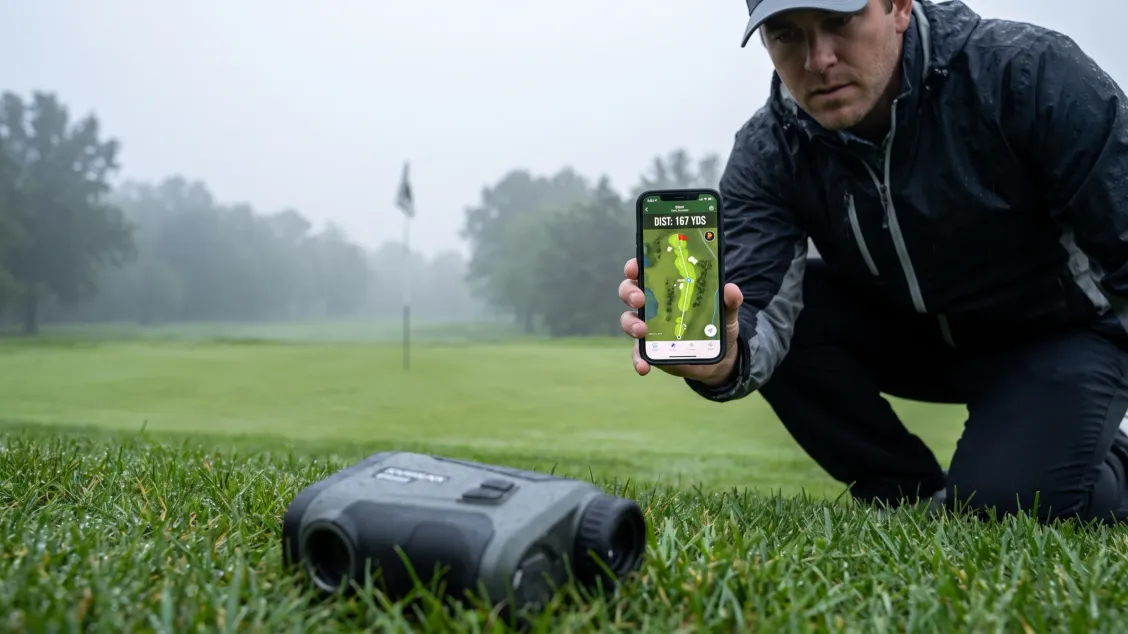
Quick answer
| App or device | Rangefinder feature | What it measures | Price (verified) | Platforms |
|---|---|---|---|---|
| Golfshot | Golfscape AR, camera view of the hole, 360-degree rotation | GPS position vs mapped green, 47,000+ courses | Free; Pro $79.99/yr | AR on iOS; GPS on iOS and Android |
| Hole19 | Augmented reality, distances and directions over the camera image | GPS position vs mapped green, 42,000+ courses | Free; Premium Pro $69.99/yr (AR is paid) | AR on iOS; GPS on iOS and Android |
| SwingU | “GPS rangefinder”, tap the flag for 5+ green tiers | GPS position vs mapped green | Free; Plus $59.99/yr, Pro $24.99/mo or $99.99/yr | iOS, Android |
| 18Birdies | Plain GPS yardages to greens, hazards, layups, carries | GPS position vs mapped green, 45,000+ courses | Free; Premium $99.99/yr | iOS, Android |
| GolfLogix | Slope-adjusted GPS distances plus club recommendations | GPS position vs mapped green, 40,000+ courses | Free; multiple paid membership tiers | iOS, Android |
| Shot Scope PRO L2 (laser) | Laser to the pin, 700-yard range, x6 magnification | Line of sight to whatever you aim at | $129.99 (from $149.99) | Hardware, no phone needed |
Disclosure first: GameCaddie builds golf apps. BallCaddie, PracticeCaddie, FitCaddie, MyBagCaddie, and ZenCaddie are all live. None of them is a rangefinder or a GPS app. Nothing in the table above is ours, and there are no affiliate links on this page.
The category name is doing a lot of work
Search “golf rangefinder app” and you get GPS apps wearing a laser’s name. Golfshot’s App Store listing is titled “Golfshot Golf GPS Range Finder”. Hole19’s is “Hole19: Golf GPS Range Finder”. SwingU describes its feature as a “GPS rangefinder that works on every course in the world”.
The word “GPS” sits in every one of those names, and it is the accurate half. These are GPS apps, and “range finder” is the search term they are chasing. The name sets an expectation the technology cannot meet.
Prices come from the same listings and the companies’ own pages. SwingU publishes its tiers as free, Plus at $59.99/yr, and Pro at $24.99/mo or $99.99/yr. Golfshot lists Pro at $79.99/yr. GolfLogix is free with several paid membership tiers and covers 40,000+ courses.
How a phone rangefinder works
Your phone never looks at the flag. It reads its own position from satellites, then looks up the hole in a database where somebody has already traced the green as a polygon and dropped pins on the hazards. The yardage is arithmetic between two coordinates.
A laser does the opposite. It fires a beam at whatever you point it at, times the reflection, and reports the distance to that object. Point it at the flag and you get the flag, on the day, in its current position.
That difference explains the thing every golfer notices first: apps give you three numbers to the green (front, center, back) and a laser gives you one. No app can give you a pin number, because the day’s pin position was never entered anywhere. Nobody re-surveys 45,000 courses every morning.
What the AR view adds, and what it doesn’t
Two of the five put the camera to work. Both run their AR mode on iOS only, even though both apps themselves are on Android.
Golfshot’s Golfscape AR shows a live camera image of the hole you can rotate through 360 degrees, with distances to the center, front, and back of the green plus hazards, layups, and targets floating in place. It won an Apple Design Award, and the basic view is free. Club recommendations are a Pro feature.
Hole19 describes its version as “point your phone to see distances and directions overlaid on your camera view. Perfect for doglegs and blind shots,” and files it under Premium, which runs $69.99/yr in the US.
Both are useful for one job: understanding a blind hole or an unfamiliar layout without walking it. What neither one does is measure. The camera supplies the picture; the GPS supplies the number. Hold the phone up to the flag and the app is still reading a polygon somebody drew last season.
What the independent tests say
The cleanest comparison comes from a device that carries both technologies in one housing. Golfalot reviewed the Bushnell Hybrid, which pairs a laser with a GPS screen, and over 5 rounds the reviewer found the laser’s reading to the flag came in closer than the GPS front-of-green number more than once. Their conclusion: “the guilty party here is probably the GPS and most likely the mapping,” on the reasoning that the laser side should be holding its claimed accuracy of within a yard.
That is the honest read on app accuracy. The error lives in the map rather than the satellite fix. A green traced slightly wide, a hole re-routed since the survey, or a temporary green in winter all show up as a yardage that is confidently wrong.
For most amateurs this matters less than it sounds. If your 7-iron dispersion is 15 yards wide, a 3-yard mapping error changes nothing about your club choice. It starts to matter when you are hitting a wedge to a shallow green with water short.
Who a rangefinder app fits
You play new courses. The AR view and the mapped hazards are worth more on a layout you have never seen than any precise number, because the question you are answering is “what am I looking at” rather than “is it 147 or 149.”
You want the yardage free. The GPS screen costs nothing in all five apps, and 18Birdies gives you GPS on 45,000+ courses with no round cap and no card.
You already carry the phone. A laser is one more thing to buy, charge, and lose. If the honest answer is that a $130 device would live in the trunk, the app is the tool you will use.
Who it doesn’t fit
You play in competitions. Elevation-adjusted yardages and club recommendations are restricted under Rule 4.3a(1), and a committee can ban devices or phones outright, so the section below is worth reading before you enter anything.
You play one course every week. After 20 rounds you know your own yardages better than the map does, and the only number you are missing is the pin. That is exactly the number a laser gives you and an app cannot.
You are hitting wedges at tucked pins. Front, center, and back is a strategy number, and on a 95-yard shot a 4-yard mapping error is the difference between the middle of the green and the bunker.
Your phone battery is already marginal. Continuous GPS plus a live camera view is the most expensive combination on this list. The Apple Watch golf app picks cover the wrist-based option that leaves the phone in your pocket.
Rules check: what you can point at the flag
Plain distance is fine. Rule 4.3a(1) says you may get information on distance or direction, so a phone screen reading 152 to the center clears the bar in most events.
The same rule is where the paid tiers run into trouble. The R&A’s own rule finder says the device must not “measure elevation changes” or “interpret distance or directional information (such as using the device to get a recommended line of play or club selection based on the location of your ball).”
Read that against the feature lists. Hole19 sells plays-like distances adjusted for elevation. GolfLogix leads with slope-adjusted distances and personalized club recommendations, and Golfscape AR puts club recommendations in Pro.
Two more things worth knowing before you tee off. A Committee can adopt a Local Rule that bans distance-measuring devices from the competition entirely, and plenty of events go further and ban phones specifically regardless of what the app does. The penalty for a breach of Rule 4.3 is the general penalty (loss of hole in match play, two strokes in stroke play) and disqualification for a second breach in the same round, per USGA guidance. Ask the committee before the round rather than after it.
A laser handles this more cleanly. The Shot Scope PRO L2 has a physical switch that turns slope off, which Shot Scope describes as making the rangefinder tournament legal. Where devices are permitted at all, that switch is a visible answer to a rules official in a way that a phone setting buried three menus deep is not.
The next step
A yardage does not lower a score by itself. What lowers it is knowing which part of your game is leaking strokes, and your handicap index is the scoreboard that tells you whether anything is working. The fixes sit upstream of the number on the screen: Find your ball with a 90-second brand-neutral fitting across 72 models, Build an AI practice plan around your actual leaks, or Get every app in the GameCaddie suite.
For deeper dives
- What is a good golf handicap? The real numbers
- Best free golf GPS apps in 2026: what free gets you
- Best golf app for Apple Watch: 2026 picks and prices
- Golf shot tracker apps: what each one costs in 2026
- Best golf launch monitor under $600: the real cost
Key takeaways
- Every golf rangefinder app is a GPS app. It reads your satellite position against a green somebody traced in advance, which is why you get front, center, and back numbers rather than a distance to the pin.
- Of the five apps here, only Golfshot’s Golfscape AR and Hole19’s Premium AR mode use the camera, both on iOS, and both draw GPS numbers over the picture rather than ranging the target.
- Golfalot’s test of the Bushnell Hybrid, which houses both, found the laser’s flag reading beat the GPS front-of-green number more than once over 5 rounds, with the mapping the likely cause.
- The paid features that make an app feel like a rangefinder (plays-like distance, slope, club recommendations) are the ones Rule 4.3a(1) prohibits, so the free tier is often the competition-legal one.
- A Shot Scope PRO L2 laser is $129.99 with a slope switch for competition rounds, which is the cleaner answer if you compete or play one course every week.